
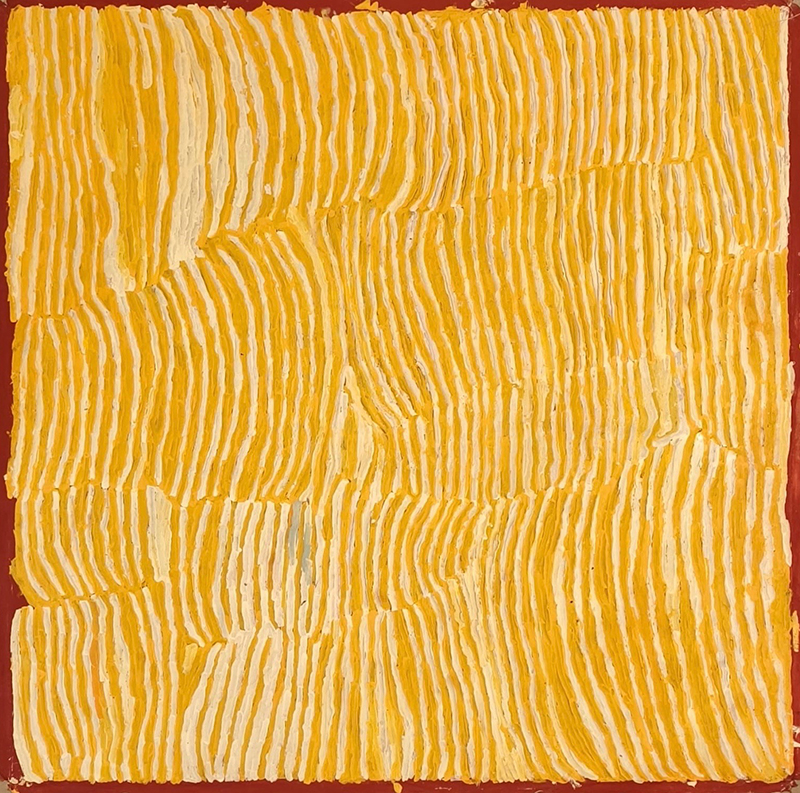

The Papunya Tula Artist’s certificate for Makinti’s painting states:
This painting depicts designs associated with the rockhole site of Lupulnga, south of the Kintore Community. The Peewee (small bird) Dreaming is associated with this site.
The lines in the painting represent spun hair-string which is used in the making of hair-belts worn during the ceremonies associated with the area’.
A group of women visited the site before continuing their travels north to Kintore.
———————–
According to (the then) Art Gallery of New South Wales indigenous art curator and NATSIAA judge Hetti Perkins, Makinti and her work are “dynamic and charismatic”.
Although a member of the Papunya Tula Artists, Makinti’s work has been described as taking “a more spontaneous approach in illustrating the traditional iconography than that done by previous artists painting at Papunya”. Her style evolved over time, beginning with gestural brush strokes in ordered compositions, and developing into more closely interwoven representations of the hair-string skirts and designs reflecting those used in body painting.[45] Throughout this evolution, her colour palette has consistently included a subtle range of yellows and pinks, through to oranges and whites.
Judith Ryan, when senior curator at the National Gallery of Victoria, described Makinti’s entry in the 2003 Clemenger Contemporary Art Award as: “concerned with touching and sensing with fingers, rather than purely visual. The repetition of colour chords and textured striations, which closely echo each other, has a rhapsodic effect akin to many bodies in dance and reveals the inner or spiritual power, the essence, of Makinti Napanangka’s country and cultural identity. The energetic lines invoke body paint for women’s business, and more particularly represent spun hair-string, which is used to make belts worn by women during ceremonies associated with the rockhole site of Lupulnga, a Peewee Dreaming place. Source: Wikipedia
———————–
Helen Read, Director of Palya Art and Palya Air Art Tours adds:
Much has been written about Makinti Napanangka’s paintings, and rightly so – with certainly more to come as appreciation for Australia’s First Nations art and culture gains global attention – helped by Makinti’s international exhibitions and inclusion into important art collections.
Available to purchase here is one of Makinti’s distinctive, rhythmic, lineal works where acrylic pigment is sensually applied expressing not only a graceful dance-like motion but an infused inclusion of the hairstring belts worn by women in ceremony and the small Peewee bird associated with Lupulnga, a rock-hole site near Makinti’s deep-desert birth place.
To talk briefly of Makinti the person, she has been described by then Papunya Tula Artists arts worker, Michael Stitfold, saying: “… by the time I met her, she was an old lady; she looked ancient. Frail and tiny, she was like a little bird. She turned up every day to the painting studio, day after day … I don’t know what happened, why she really couldn’t communicate that much – she had a speech impediment – but when she finished a painting she would motion you over and talk about ‘lupul, lupul’, pointing to the painting, then tucking her hands up under her armpits and gently flap her wings like a little bird.
“When it was just Makinti and the ladies in the studio she was part of the fabric of that studio; she loved it when the ladies would sing and she would hum along a little bit. She seemed to me that she was just this little bird that you wanted to protect. She was a beautiful, contented soul who expressed herself through painting. Yes, she was a beautiful soul”.