

Ngipi Ward AM was born around 1949 in Tjirrkaupa, near Patjarr (Karliywara), a small community in the Gibson Desert situated in remote mid eastern Western Australia, 200 kms north, by road, of Warburton. A Ngaatjatjarra speaker, Ngipi Ward AM has been described by then Kayili Art Centre Manager, Michael Stitfold, as ‘A classic, classic, desert lady’, saying:
“She had a house and pretty much lived on the verandah with her flock of dogs, and always with a canvas (a linen surface stretched over a frame ready to paint on) – it was just like part of her camp, part of her ‘kit’.
“She always wanted to go hunting. Sometimes I would take the ladies out on Country Friday morning and pick them up Monday evening having dropped them off with blankets, jerry cans of water, a few tins from the store, a pannikin, tea, a crow-bar and box of matches. Though tiny, Ngipi was always the keenest, hardest hunter; she would sometimes come back with a Parenti (large lizard) that young men would use a gun to kill. She was a great tracker and loved Bush Turkey and Goanna. She was always talking, talking, giggling to herself, a small wad of minkurrpa- tobacco bought or bush mixed with ashes under her top lip. Ngipi knew when the trees would flower and collect the seeds, grind them up for damper. Sometimes we’d go down to the lake and dig for rabbits. She was so strong.
“It was hard to tell where Ngipi’s mind was but it was in another realm, it was out there in the bush. She loved her dogs and she loved it when the sun-light changed; she would smile, like she was just so present in where she was.”
Text: Helen Read
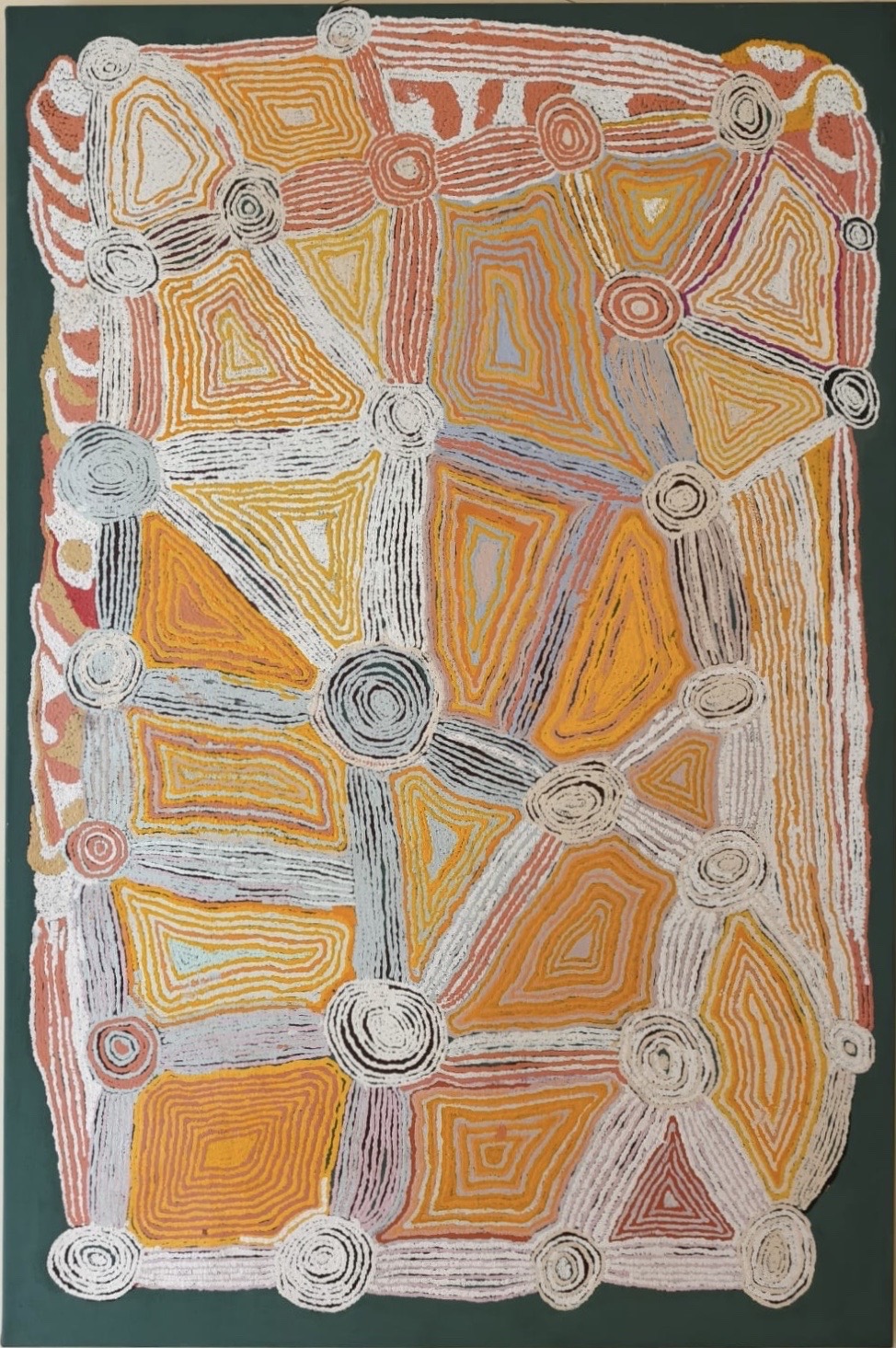
The Kayili Artists certificate for this painting, titled Kapi Purlkanya’ states:
This painting shows many important rockholes that are part of the Tingarri * songcycle. Wandantjarri area features a big, deep hole which Tingarri people (men, women and children) drank from and caped near. One time a wedge tailed eagle (warlawurru) with a face like a man swooped down, taking a young child (titji). This site is represented by one of the circles in the painting. The Tingarri people then travelled to other water places.
Ngipi has also painted Kurratjiti – a creek bed running of (sic.) some rocky hills in the artist’s grandmothers country west of Patjarr. At this place there are two rockholes and the women collect the seeds of an Acacia tree, which they beat from the branches, then winnow to separate the seed from the husk. Once the seed is cleaned the women grind it up mixing it with water to make a paste called lungkunpa which is eaten raw.
This painting shows many water sites: Nanpurna, Pirringnya, Yarpan, the creek bed called Tjantiwarra, and Tjurnga (a large rockhole). To the north are Yarrpan and Yirrin, and Kutjaranya, east to the claypan of Patantja.
At Tjani there are two rockholes. This is the country that belongs to Ngipi’s grandfather and that she has lived and walked.
* Tingarri song cycle depicting the route of dreamtime people who travelled from the sea near Pt. Hedland to the northern part of the central desert. It also refers to the route and to the dreamtime people who followed that rouge. (source: Ngaanyatjarra to English Dictionary: IAD Press).